Use our Truck Loan Calculator to estimate repayments, compare finance options, and plan your purchase with ease. Fast, simple, and tailored for Australian businesses and drivers.
Calculator results are general estimates only and not quotes or offers of insurance or credit. Outputs are illustrative, do not take into account your objectives, financial situation or needs, and do not constitute personal advice or credit assistance. Insurance calculators relate to referrals we make under our Australian Financial Services Licence authorisation, and loan calculators relate to referrals we make under our Australian Credit Licence arrangements. Actual eligibility, premiums and repayments will be confirmed by a licensed adviser or broker after they review your enquiry.
Truck Loan Details:
Important!
Truck Loan Interest Rates differ from lender to lender and will depend on your individual circumstances (credit history, employment status, age, etc.). To find out if you qualify ... and for a free, personalised interest rate and repayment quote, please CLICK HERE
Truck Loan Amortisation Calculator
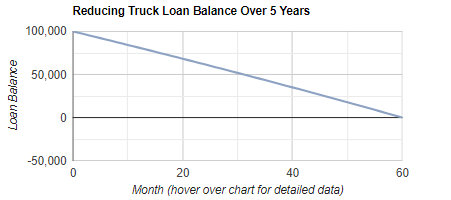
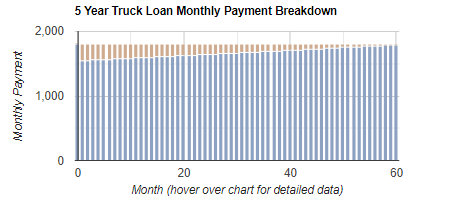
The following amortisation graphs detail month-by-month data on the progress of the proposed loan. The first chart below examines the reducing loan balance over the course of the finance contract term. The second graph illustrates the portion of each monthly repayment allocated to payment of interest vs principal reduction.
How to use our Truck Loan Repayment Calculator
Our Truck Loan Repayment Calculator helps Australian drivers and businesses estimate loan repayments before you commit. It is designed to support budgeting, cash flow planning, and comparing truck finance scenarios by showing how changes to price, deposit, term, and interest rate can affect your repayments and total interest cost.
How to complete the calculator for the most accurate estimate
1. Purchase Price
Enter the total purchase price of the truck you plan to finance. Consider including eligible on-road and purchase-related costs that may be financed (for example registration, insurance, or other costs where applicable). Use whole numbers only, without commas or decimals.
2. Deposit or Trade-in Value
If you are paying an upfront deposit or using a trade-in, enter that amount here. This reduces the amount you need to borrow and can lower repayments and total interest. Use whole numbers only.
3. Term of Loan (Years)
Select the loan term in years. In general, a longer term can reduce the periodic repayment but may increase the total interest paid over the life of the loan. Choose a term that suits your expected truck usage and business cash flow.
4. Interest Rate (Percent per annum)
Select an interest rate to model your scenario. Rates vary by lender and borrower circumstances, so it can be helpful to test a conservative rate as well as an optimistic one.
5. Calculate
Select calculate to generate your repayment estimate and repayment breakdown visuals.
How to interpret your results
1. Repayment estimate
Use this as a guide to affordability and budgeting. If the repayment is tight, test a higher deposit, shorter term, or different interest rate.
2. Amortisation and graphs
Review how the loan balance reduces over time, and how each repayment typically shifts from mostly interest early on to more principal later. This can help with planning for refinancing, early payout, or upgrade timing.
ASIC compliance note: This calculator provides information only and is not financial or credit advice. Results are estimates and may not include all fees, charges, taxes, residuals or balloon payments. Consider your objectives and financial situation, and seek independent advice or a lender quote before proceeding.
Recent insurance industry reporting has again put cyber risk in front of small businesses, with a clear message for trade operators: digital exposure is no longer limited to office-based companies. Many electricians, plumbers, builders, landscapers and subcontractors now rely on cloud quoting tools, job management apps, online banking, electronic invoices and customer databases to keep work moving. - read more
The latest catastrophe-focused commentary from Australia’s general insurance sector has arrived with a practical warning for trade businesses: severe weather is no longer a once-in-a-while planning issue. Storms, floods, hail, bushfire and damaging winds are continuing to influence claims volumes, repair costs, underwriting appetite and premium pressure across the market. - read more
ASIC’s continuing focus on insurance pricing has delivered another reminder that renewal documents deserve close attention, especially for tradies managing several policies across their business. Recent regulatory action against an insurer over alleged pricing and discount failures reinforces a practical point: the final premium shown on a renewal notice may not always tell the full story about how that amount was calculated. - read more
APRA’s latest general insurance data has again highlighted a point many Australian tradies are already feeling at renewal time: a healthier insurance sector does not necessarily translate into simple or immediate premium relief for small businesses. While insurers continue to operate with stronger capital buffers and improved underwriting discipline, the costs sitting behind many policies remain under pressure. - read more
The national ban on engineered stone has shifted from a regulatory headline into a practical operating issue for Australian trade businesses. Since the ban began in July 2024, regulators have continued to emphasise that uncontrolled work with crystalline silica can expose workers to serious and irreversible illness. For builders, stonemasons, kitchen installers, tilers, demolition contractors and renovators, the message is clear: compliance is no longer something to deal with only when a job looks high risk. - read more
A certificate of currency is commonly requested before a tradie starts work on a site, signs a contract or completes a client onboarding process. This guide explains what it shows, why clients ask for it and what to check before you send one. - read more
Creating a monthly budget is essential for any business, but it holds particular importance for small trade businesses in Australia. Effective budgeting can help you manage cash flow, allocate resources efficiently, and ensure financial stability. - read more
Trades insurance is a type of coverage specifically designed to protect those who work in various trades, such as electricians, plumbers, carpenters, and builders. It encompasses a range of insurance products tailored to address the unique risks and challenges faced by tradespeople in their day-to-day activities. - read more
Australian trade businesses may need workers compensation insurance when they hire employees, apprentices, casual workers or certain contractors. Obligations vary by state and territory, so tradies should check the rules before growing their team. - read more
Insurance is a crucial safeguard for everyone, but for subcontractors, it's essential. In the world of trade professionals, the tools of the trade are more than just pieces of equipment; they are investments into one's livelihood. - read more
Knowledgebase
Insurance Claim: Notification to an insurance company requesting payment of an amount due under the terms of the policy.